Do you fill every empty moment with scrolling, and wonder why your mind never seems to slow down? If you tend to overthink and feel overwhelmed, this one is for you. In this episode, I share the simple daily routine I use to care for and calm my mind. It’s not a rigid formula: take what resonates, leave the rest, and build a version that fits your life.
In this episode, you’ll learn:
- Six daily habits that support a calm mind, and the research behind each one
- How to build them into a routine that fits your life instead of adding pressure
- What to do with the empty moments you currently fill with scrolling
LISTEN NOW:
CLICK HERE TO LISTEN TO CALMLY COPING WHEREVER YOU LISTEN TO PODCASTS
WATCH NOW:
📚 RESOURCES + SOURCES MENTIONED
Evening Routine to Calm Your Mind & Disconnect from Work: https://www.becalmwithtati.com/evening-routine/
Morning Routine to Reduce Anxiety & Overwhelm: https://www.becalmwithtati.com/morning-routine-for-anxiety/
Research:
- Naming emotions: https://doi.org/10.1111/j.1467-9280.2007.01916.x
- Writing on paper vs. typing: https://doi.org/10.3389/fnbeh.2021.634158
- Gratitude: https://pubmed.ncbi.nlm.nih.gov/12585811/
- Exercise and school performance: https://pubmed.ncbi.nlm.nih.gov/19356688/
- Exercise vs. antidepressants: https://pubmed.ncbi.nlm.nih.gov/10547175/
- Exercise, memory, and focus: https://pubmed.ncbi.nlm.nih.gov/18094706/
- Social media and depression: https://doi.org/10.1002/da.22466
- Social media, depression, and anxiety: https://doi.org/10.1016/j.chb.2016.11.013
- Why emotional content spreads: https://pubmed.ncbi.nlm.nih.gov/28652356/
FREE TRAINING: Achieve A Calm Mind, Balanced Life, & Empowered Confidence in 90 Days
If you want to learn how to take back control of your life so you can feel calmer and more confident, and learn the tools to spend your time according to what matters most to you (no matter what your schedule is like right now)…
LISTEN, REVIEW, AND SUBSCRIBE TO THE PODCAST!
INTRO/OUTRO MUSIC: Rescue Me (Instrumental) by Aussens@iter (c) copyright 2018 Licensed under a Creative Commons Attribution (3.0) license. http://dig.ccmixter.org/files/tobias_weber/57990 Ft: Copperhead
DISCLAIMER: All content here is for informational purposes only. This content does not replace the professional judgment of your own mental health provider. Please consult a licensed mental health professional for all individual questions and issues.
Interested in diving deeper to get support for high-functioning anxiety?
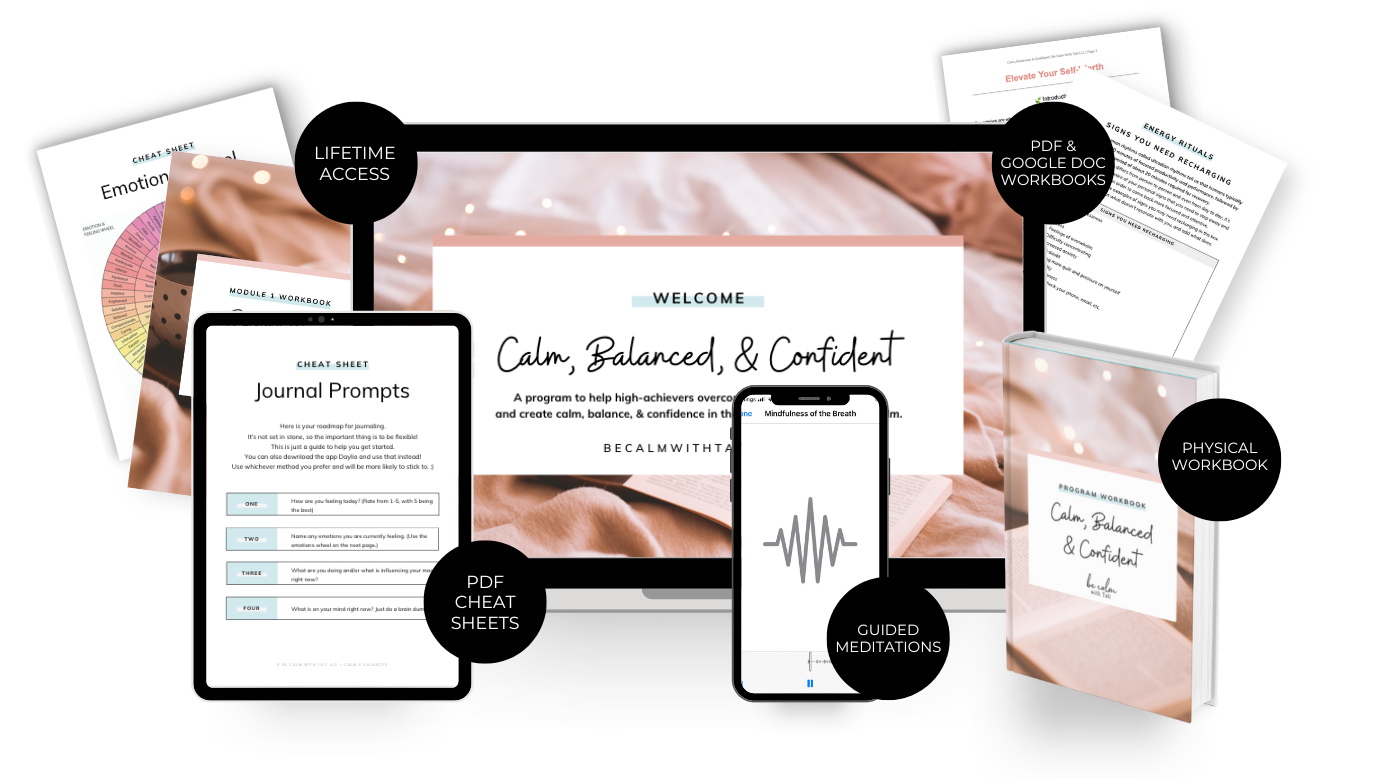
Calm, Balanced, & Confident is my comprehensive A→Z self-paced course to help high-achieving professionals overcome high-functioning anxiety so they can feel calmer, balanced, and more confident without the anxiety and overwhelm. Click here to learn more and enroll today.
TRANSCRIPT:
Click to view the episode transcript.
The things you do affect how you feel. They affect your thoughts and what’s going on in your mind. So many of us tend to default to scrolling in empty moments, waiting online, at the end of the long day to shut off our minds, but then we don’t engage in intentional habits that support our mental health, focus, attention, and other important cognitive functions.
Your brain is one of your most valuable tools, and just like your car, your kitchen knife, or your phone, you have to tune it up, sharpen it, charge it, and wherever else this analogy will take me. In this episode, I’ll share a simple daily routine to help you care for and calm your mind daily, especially if you tend to overthink things and feel overwhelmed
Welcome to Calmly Coping. I’m Tati Garcia, a licensed therapist. Every episode, I help you get to the root of the anxiety, overwhelm, and pressure of holding it all together, and what actually works to shift it. If that resonates, then follow or subscribe wherever you’re tuning in. Let’s get into it. As with any daily routine or habits, this is not a rigid formula to follow.
Take what resonates and leave the rest. Adjust and fit it into your lifestyle, and make moderations as needed. This is not about doing things perfectly, but about finding what works for you. So the key to a calm mind is practicing increasing awareness of your thoughts so you know what’s going on, creating space to process and reflect, practicing recognizing the positive, movement, consuming information intentionally, and planning and prioritizing intentionally.
And I’m going to dive into each one of these and something specific you can do to address it, and I’m also gonna share why these are so important. So first, practice increasing awareness of your thoughts through a five-minute meditation. Mindfulness meditation is the practice of choosing a focus, such as your breath, and bringing awareness to that.
Then notice when thoughts come up, because they will, without judgment, and bring your awareness back to your focus, in this case, the breath. It’s that simple and that difficult. Think of this as a bicep curl for your mind, as mindfulness instructor Corey Muscara says. It’s training your attention and also increasing your awareness of what your mind does all day long.
The intention is not to stop thinking, but to become aware of and change your relationship with your thoughts so that you can understand and relate to them differently. Take just five minutes to be present with yourself. It’s so important to not just calm your mind, but to learn how to turn inwards and listen to yourself, a skill that so many of us have lost.
And you don’t have to overcomplicate this. I set a simple five-minute timer so I can do it screen-free, but there are also so many different meditation apps out there you can try if you’re new to this. My second habit is to create space to process and reflect through the practice of journaling for just five minutes and reflecting on what’s on your mind.
I do this right after my five-minute meditation. I reset that five-minute timer and free write. What’s on your mind? How are you feeling? Connecting with your emotions is an important part of the journaling process, which helps you to name them in order to work through them, because unacknowledged or suppressed emotions tend to build up and come out in unhelpful or harmful ways.
Be sure to let it out without judgment. And bonus points for writing in a physical journal because your brain just tends to process that differently than typing into your phone or computer. Just having the space to let things out can be helpful, especially if you tend to hold things in or don’t have any other space to let out what’s on your mind.
My third habit is to practice recognizing the positive by identifying three things you are grateful for daily. And I like to do this right after my journaling and identify what I’m grateful for, big or small. The key is to tune into the emotion. How does thinking about drinking your morning cup of coffee make you feel?
Or the cozy comfort of a rainy day, or the love of your family? Practicing gratitude builds your brain’s muscle of recognizing the positive. And according to positive psychology research, when you flex this muscle regularly, your perception begins to change. You start noticing more positive things that were probably already there and you may not have noticed them before.
You start noticing more possibilities, opportunities, and appreciating what you already have, rather than feeling like it’s never enough. So one, two, and three all take less than 15 minutes, and that’s something you can do as a simple way to start your days, or fit it into any moment of your days Now let’s move on to number four, which is movement.
There are so many benefits to moving your body for your mental and cognitive health. Research shows that children performed better in school after gym class, and it also shows that physical exercise is as effective as antidepressants, which are used for treating both anxiety and depression. Physical activity improves not only your mental health, but your memory, your focus, your ability to learn, and many other important cognitive functions.
So make time to move your body regularly. It doesn’t have to be an hour-long exercise class or something you hate doing. Find something you enjoy and that you will stick to and do it. Even if it’s going for regular walks or yoga, cycling or going to the gym, find what works best for you. Number five is to consume information intentionally.
This isn’t necessarily part of a routine, but something that you can bring awareness to throughout your entire day. And a simple way to do this is to reduce screen time. But information can also come through other avenues, so modify to your life. For example, if you find you wake up and open social media, scroll through the news, and check your inbox all before you’ve gotten out of bed, you are exposing yourself to so much noise before you’ve even had a chance to connect with yourself and check in with how you’re feeling, to even look out your window.
What you consume influences how you feel, how you think, and how you see the world, even if you think it doesn’t. And the more you don’t think it does, the more susceptible you are to its influence But ultimately, we are all susceptible. And the thing with algorithmic content or the news is that it’s optimized to capture our attention, and the content that captures your attention is often the kind that elicits strong emotions.
It could be of any type, but oftentimes it’s anger or envy. And research across the board shows that people who spend more time on social media tend to have more depression and anxiety. And of course, correlation does not equal causation, meaning that people with anxiety and depression could be more likely to spend more time on social media, or social media could cause these challenges.
But regardless of the cause, as humans, we have not evolved over hundreds of thousands of years to have access to this much content, these many people, these many opinions, all within minutes. In other words, our brains just cannot handle and process all of this information. Intentional technology usage and information consumption could have a massive effect on how you feel and calming your mind.
Even if it feels uncomfortable to start with, it is something that can help over time, and the key here is to have something to replace it with. If you’re standing in line, practice just being present rather than checking in on your phone. I do that all the time, and I’m often the only one looking around when everybody else has their nose in their phone.
And this isn’t to be superior or anything, but it’s just an interesting observation how over time it’s become more normalized to be doing that, whereas if you go back 15 20 years ago before smartphones even existed, it was seen as rude to do that. And you can replace this with anything you enjoy. Maybe the times that you’re sitting and tending to scroll, try replacing it with reading, grabbing a magazine, yes, those exist, or a crossword puzzle book, or even keeping a physical notepad to take down notes, crafting or engaging in a hobby, or even watching a TV show you like.
Because this is an intentional choice. You are choosing what to commit your time to rather than an algorithm deciding for you. And stepping down from my soapbox to the final habit, which is to plan and prioritize it intentionally. When you have a to-do list that’s a mile long, have tons of things going through your mind, and worry about getting it all done, that creates more stress, anxiety, and rumination.
So that’s when it helps to plan your priorities, ideally at the end of the previous day. I look at my calendar and to-do list for the next day and identify my priorities and tasks, no more than three to five, that must be done, and write them down. When you do this, you are taking just five minutes to create a plan in advance so you don’t go to bed or wake up the next day worrying about what’s on your plate or with your brain spinning.
And those are my suggestions for a simple routine to a calm mind daily. If six habits feels like a lot, then start with just one to two and see what you notice from that. Or, as I said in the beginning, take what resonates with you and leave the rest. You don’t, by any means, need to do all of these things every day.
And in fact, having too rigid expectations with routines is the opposite of cultivating a calm mind, and it can actually create more stress and pressure. Leave a comment below and let me know what habit helps you calm your mind daily. I’d love to hear from you.
And while you wait for the next episode, I have other episodes to calm your mind, improve work-life balance, and feel more confident from within. So be sure to check out another one. Thank you so much for tuning in today, and until next time, be calm


Until next time…